APPENDIX D: Language - Some Important Principles and StrategiesD.01 Principles (1) Human Behaviour (in the context of linguistic communication), has Evolutionary Origins. The ability to understand a statement which is couched in linguistic form, could not have arisen by magic or from nowhere. It must have evolved from some pre-existing ability by means of which our ancestors could "understand" the events and circumstances which they were able to perceive. I use the term "understand" deliberately to emphasise that the degree of knowledge and intelligence involved, greatly exceeded simple recognition of circumstances, followed by automatic pre-programmed responses. Our ancestors - human forms, and before, them other species, must have been able to predict the likely consequences of the events they perceived and also the consequences of actions that they themselves may have chosen to perform as a response to those events. That is, they must have been aware of the consequences which might have followed, even if these consequences were not, in fact, the observed result. To react, particularly to dangerous events, we must be able, to some extent, to anticipate outcomes. In some circumstances our ability to survive depends upon our ablility to do that. The ability to communicate with other people in our social community represents a huge enhancement to our abilty to gather information about of our environment. Prior to that we were limited to what we could learn using mainly using our own powers of perception. We must have been able to read body language to some extent, but linguistic communication gave a huge boost to the detail which we could obtain from others. It would seem unlikely therefore if that new information would then be processed in some completely new way. I assume, therefore, that when we gained useful information from others, we stored that information, and made use of it, in precisely the same way as we had previously done, in order to choose the nature of our subsequent behaviour. (2) Minimum Elaboration This principle advises us, when a representation of some event or circumstance is being constructed, we should not state explicitly any detail concerning which we have no explicit information. It is also equivalent to making an assumption that the normal condition prevails. For example, when we need to construct the representation of a person, we should assume that that person has the normal complement of arms, legs etc. - but that we should not make that assumption explicit. That is, we do not actually represent the person as having that number of limbs. The rationale for that approach is that because the structural features of a representational structure can be modified easily, we can afford to wait until explicit information is available before elaborating the actual number of limbs. If the facts are important, those facts will be provided within the conversation in due course. I adopted this principle at an early stage in my exploration of the topic when I read a paper by John McCarthy on what he termed "Circumscription" (McCarthy 1980). It was a clever idea, but I decided it was not one I could adopt. According to McCarthy we should anticipate certain exception conditions and make provision for them in the representation of entities which normally behaved in one way, but could in exceptional cases behave in some other way. If events were always so predictable, that might have been good advice. But the real world is "chaotic" in the mathematical sense, so I prefer a strategy of ensuring that we should use representational structures which can be pulled apart easily, modifications made, and then reassembled. (3) Causal Connectivity is the Key To facilitate that strategy easily realisable, the main device I offer, is the "causal connection". Elsewhere in this text I showed how a causal connection constructional unit, and its derivatives, units which represent "preventing" and "allowing" could be incorporated into representational structures. With these we can construct a representation of some condition which will permit automatic prediction of future events and conditions. (4) Constructing an Understanding IS Being Conscious My thesis is that to be conscious, means being engaged in the process of creating the structure which represents the events and conditions. This process has existed prior to being able to use language, but language use reuses that bit of the same procedure. The experience of a conscious state requires certain other bits of that important procedure to be actively engaged. First there has to available a structure (in this text called "SELF") where the structure representing experience can be stored for later recall. Note, however, that what is actually stored is not the finished structure, i.e. not merely that representation of events and conditiions. What is stored is the means by which that structure can be re-created. It is the construction process as it is being performed that corresponds to being conscious. That, I suggest, is why memory recall, which requires the structure to be re-built every time, requires effort (consumption of energy). If memory storage is not carried out, then we can be momentarily aware of what we are doing, and may be able to understand what is being experienced to a considerable, but that experience cannot be recalled later. That means that events and circumstances must be instantly forgotten after being experienced. If a creature is in that state it will never be able to be aware (and thus able to confirm) that it has had any experience of consciousness, whatever. And that implies that when we take our reports of being conscious, as evidence of being conscious, we are in danger of making a serious mistake. My explanation of how we are able to use language, suggests that in order to do that, we must be able to use that same "being consciously aware"procedure, and thus it is not possible to use language without being conscious simultaneously. To use language we introduce a secondary procedure which interprets the sound of spoken words, makes the approriate identification of the concept associated with each word, and then builds that structure using those concepts as (as it were) building bricks - (i.e. analogous to jigsaw pieces). Written language requires yet another addition to that process which engages visual preception as yet another preliminary part of the complete procedure. Note that this is, what I have called, a "working explanation" of our ability to use language as a means of communication. It is therefore able to help us to make useful predictions. Note that my explanation does not reject outright any role for syntax, but it does relegate syntactical knowledge to a secondary role. Syntax then becomes a relatively sophisticated adjunct to the use of language, It clarifies and assists the understanding of utterances. In many circumstances, however, it is not an essential ingredient of language use. Allow me to reinforce that argument against a orimary role for syntax. Consider the evolution of the ability to communicate. Language, in its fully developed form, must come gradually through various stages of grunts, nods, gestures and an increasingly elaborate body-langauge. If the Chomskian idea is correct, then at what point in that gradual development does syntax take over? When we are interpreting the implications of facial expressions as a means to predict the behaviour of another person are we using the same mental processes as we used before that (with a small addition), or are we using and innate knowledge of some kind of "deep grammar"? Explain please - where did that come from and why was it necessary? Move to a later point in that gradual development of syntctical knowledge - a point where we can use single words. We point at a person and say "Fred". Why do we need Deep Grammar to understand that? Or later still. When we say the equivalent of "Now paddle straight ahead". And later "Harder". Does any of that necessitate knowledge of syntax? Or does it require only a knowledge of certain words, like "Now" and "paddle" and the two-word phrase "straight ahead" - which, in this case, could be processed as though it was one word. And then later, as we sit round a fire and remember what we have experienced both by direct perception, and by verbal communication (and have trouble remembering which kind of information and experience was gained in which of these ways), consider this - do we really need two separate mental mechanisms of understanding? D.02 An Example 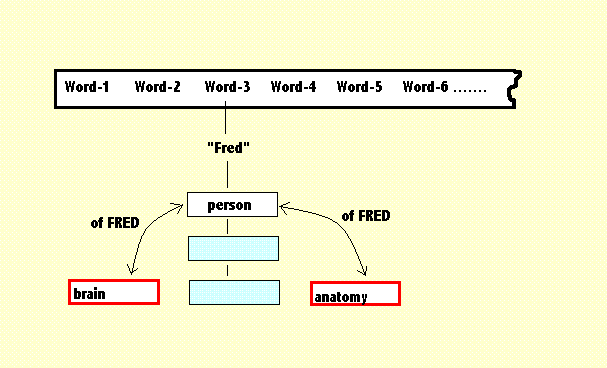
In this example we have no unusual information about FRED. The other words in the utterance which is being processed, have not been identified. One of them may be a verb. In which case it will probably involve some action. That action can be described - the movement of objects from one location to another. It may also have causal connections which could tell us why those objects moved. Perhaps Fred kicked a ball. If so, his leg must have moved so that his foot made contact with that ball. Persumably the ball then moved. Are we told the location? Are we told what caused that kick to take place. If it Fred's brain which caused his leg to move, then that kick was deliberate not accidental. All of that can be described in this narrative. The next diagram shows a later stage in the process. 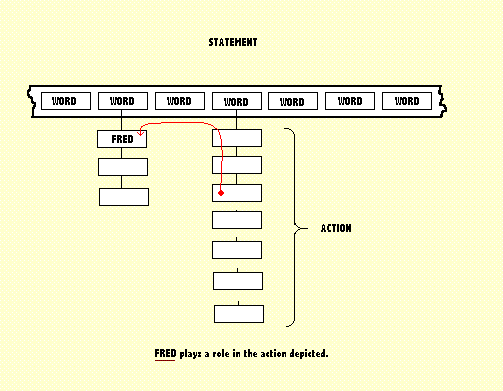
The problem then is to provide a mechanism by which the processing mechanism can discover who it is that is the agent of this action. It is at this point that syntactical knowledge becomes useful. It is my contention, however, that that knowledge is acquired by habit and repute. The person who acquires this knowledge does so by listening to others speaking. Notice the curved red arrow which links the structural location of the agent of the action, with the structure representing FRED. That red arrow represents a procedure lodged in the structure of the verb. That procedure seems to know where to look for the agent of the action and I suggest that that ability was acquired by listening to the prevailing speech patterns of the community. If the utterance had been expressed in passive voice, there would have been a different verb structure. The procedure which is embedded in the verb, conducts a search, and knows that if it encounters a verb-structure such as "has been" coupled with a past tense to produce the word sequence "has been kicked by" ... it knows that the normal search pattern must be reversed. That is a heuristic rule which can be learned (and if necessary unlearned). The rules of syntax are not immutable. They are characterised by fashionable trends. D.03 Other Word Groups There are various other word groups which need to be identified and located, before some utterances can be fully analysed. Perhaps the most important of these are the noun phrases and for that to be possible, the insights provided by syntax, become increasingly important. Fail that, there are two "fall-back" options or alternatives. (1) To ask for clarification. This is feasible when we are analysing the text of a conversation. (2) To develop and store alternative analyses - then process more of the text, in the hope that clarification may (eventualkly) be discovered. The single word "Fred" can be a single word noun phrase, which is why I chose that for my example. Other noun phrases may contain several words and can become quite complicated. There can (as in the example above), be several adjectives and adjectival phrases, all of which (as in this case), provide additional information to the main noun (dog). Sometimes the main noun is not always obvious. Sometimes too, there can be an ambiguous choice. And sometimes also there is a careless use of pronouns which is inherently ambiguous. In those instances, the technique I suggest is to embed a procedure within the meaning structure of each pronoun and this, when activated, will search backwards (the is, leftwards in the word sequence) in an attempt to discover a likely referent. Failing which we can adopt an appropriate "fall-back" option. The analysis of adjectives, is a search forwards (to the right) to find an approriate main noun. This can be complicated by noun phrses which contain two nouns, of which the first is being used as a kind of adjective - This type of confusion can usually be solved by adopting fall-back (2), which will often reveal that there seems to be an extra unattached noun. On the topic of other types of word groups, each natural language has various additional word-type which act as linguistic sign-posts. These can be read and used to direct and control the embedded search procedures as they try to find their appropriate referents. These are words and phrases, like "then", "by", "after", "while", "by means of", "which", "because", and so on. D.04 Context Dependency In the main text, in section 4.16, I discussed the issue of context dependency and introduced the example sentence - "John kicked Bill on the knee, one the spur of the moment, on a Saturday, on a bus, in anger, in December, in the middle of the night, in the middle of an argument .... " And drew attention to the different interpretations that might, in that example, be associated with the prepositions, "on" and "in". That is yet another example of context dependency. In each of the different cases, a word which follows the preposition, establishes a differect context. Consider, for example, the words "December", "bus" and "anger". "December" is a period of time (with a host of seasonal associations), the "bus" is a physical entity which has a mobile physical location while "anger" describes a state of mind (and an emotion) which carries with it an expectation of a particular kind of behaviour. In general the syntactical approach tries to classify these contexts - but not in these particular instances. The classifications are word-types - noun, prepositions, gerund, and so on. These are not a great deal of help. What we could do as an alternative, is to add some semantic information, which might be rather like a short entry in a dictionary. "Time Period", "Vehicle" and "Emotion". The interpretation of each prepositions would then start with a search for contextual clues of that kind, foilowed by a selection of what might be the most appropriate procedure which would then incorporate the meaning of the prepositional phrase into the growing depiction of the complete sentence. More detail could be added but I would prefer to resist that embellishment. The introduction of the phrase "in anger" is interesting and illustrates that we cannot avoid the issue of the interpretation of emotional states. What that phrase does, is to introduce an expectation of future events. We can image how that sentence might have continued. If the next part of the text had been - We might reasonably have expected that laugh to be a fiendish cackle, and not an expression of genuine mirth. My approach to these issues would be to deal with that by introducing the construction of just such an expectation - and that would take the form of a prediction of events at some future time. That prediction would be introduced as a component of the concept associated with the word "anger". Notice how readily a mechanism of that kind could be misinterpreted as the (emotional) motivation which caused that predicted behaviour to be performed (rather than preparations for its performance which it actually is). Notice also that these prediction could also be quite accurate and in that way these predictions could provide significant survival benefits to an evolving intelligent social species. That is another example of why I think my approach is superior to the syntactical one. (see section 5.05 of the main text for a formal definition of emotions). D.05 In Conclusion I cannot claim to have covered all of the relevant issues raised by my suggested approach. I do claim, however, that my approach, which is based on semantic analysis rather than syntactical analysis, is sound, has placed these techniques in an appropriate relationship, and is worthy of further development.
|